

Looking for Luxury Desk Objects? Here Are 10 Things You Should Know Before You Buy
Most desk objects are designed to occupy your hands for a few minutes. The better ones give your attention somewhere to settle.
A luxury desk objects should do more than fill an empty corner. It should offer satisfying movement, thoughtful construction, and a reason to keep looking. For watch enthusiasts and engineering hobbyists, that often means choosing mechanical desk decor over plastic novelties or battery-powered gadgets.
Mechanica takes this idea in a distinctly horological direction. We recreate the visual principle of a tourbillon at a scale large enough to hold, wind, and admire. The escapement is exposed. The spring tension is visible. The movement is powered by your hand.
No electronics. No batteries. No motors.
Before you buy a luxury desk object, here are 10 things worth considering.
1. Decide what you want it to bring to your desk
Begin with the experience.
Are you looking for a conversation piece? A calming object between tasks? A small display of engineering? Or something tactile to handle while thinking?
The best executive desk objects can serve several purposes at once. They bring visual interest to a workspace, provide a short hands-on ritual, and give visitors something unusual to ask about.
A kinetic sculpture has an additional quality: it changes as you watch it. The object is never quite still when it is running.
2. Look for genuine mechanical movement
“Moving” does not always mean mechanical.
Some desk sculptures are motorised. Others use magnets, batteries, USB power, or continuous rotation systems. These can be effective, but they create a different experience from a manually wound mechanism.
For watch lovers, the appeal lies in stored energy being released through a controlled sequence of components. A mainspring drives the mechanism. The escapement regulates the release. The balance oscillates. The cage turns.
That relationship between energy, resistance, and motion is central to the charm of a mechanical desk object.
3. Examine the mechanism, not just the silhouette
A sculpture can look impressive from across a room and reveal very little up close.
Before buying, look for clear product photography and close-up views of the moving parts. Can you see the escapement? Is the spring visible? Are the gears, balance, and rotating cage exposed?
Mechanica’s Tourbillon Orbit is built around an enlarged bi-axial tourbillon layout. The movement is designed to be observed rather than hidden inside a case.
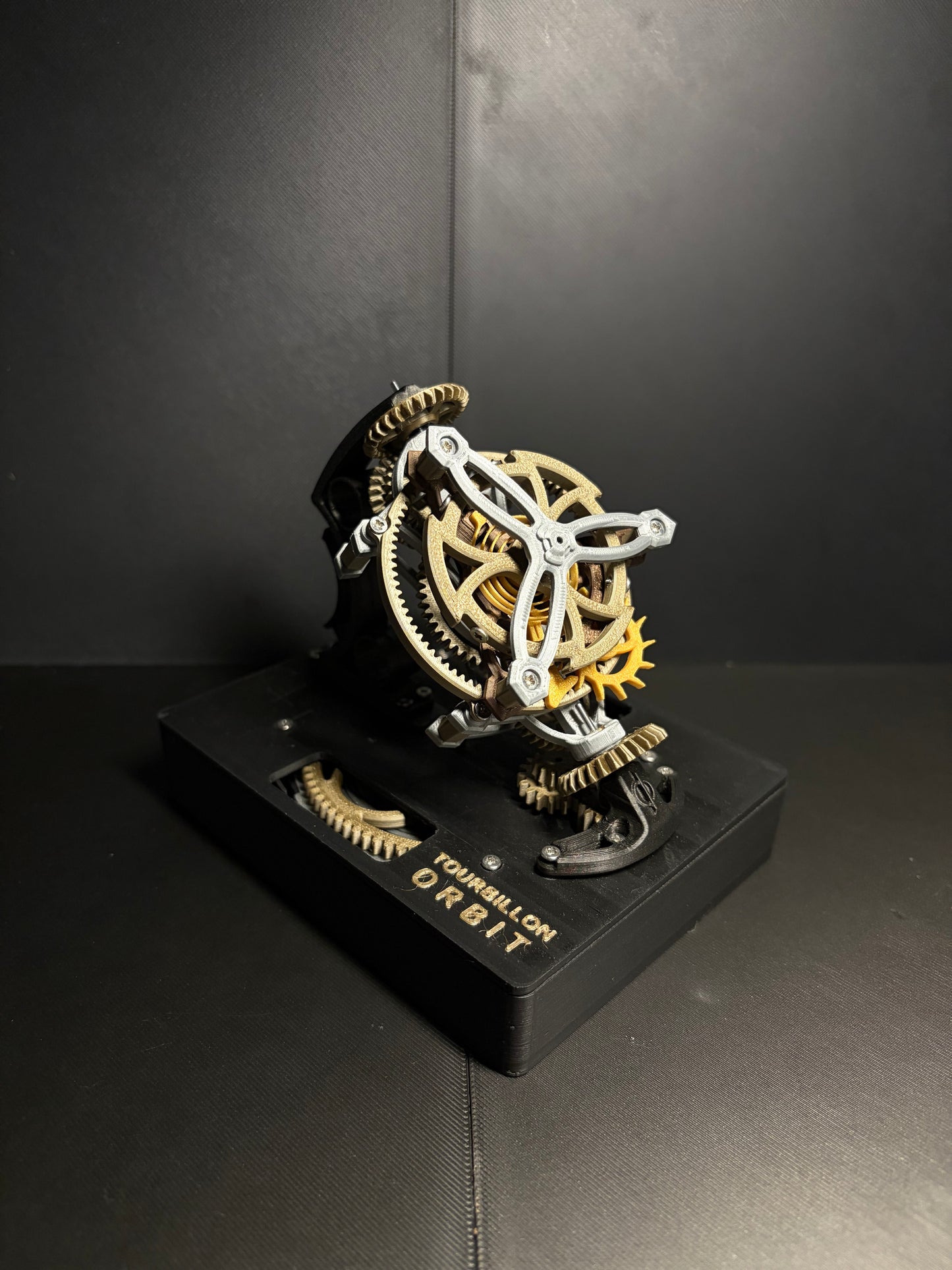
A traditional tourbillon is usually only a few millimetres wide inside a watch. At that scale, appreciating the movement often requires a loupe or magnifying glass. Enlarging the mechanism changes the relationship completely.
You can hold it. Wind it. Watch each stage of the cycle.
4. Pay attention to the sound
Sound is part of a mechanical object’s character.
A motor may produce a hum. A loose assembly may rattle. A well-tuned escapement produces something more restrained: a soft, controlled ticking that makes the movement feel alive.
This is the tactile mechanical ASMR of a spring-powered sculpture. You feel the winding resistance through your fingers. You hear the escapement begin. You follow the movement with your eyes.
One verified customer described the experience simply:
“It gives off a satisfying ticking sound when activated. It is mesmerising to look at the hairspring while the cage makes its graceful procession.”
The right sound should support concentration, not compete with it.
5. Check the power source and running time
A luxury desk object should be clear about how it operates.
Ask whether it needs batteries, a cable, a motor, or manual winding. Also check how long it runs after activation. These details determine whether the object becomes part of your daily routine or remains a passive ornament.
Mechanica is powered entirely by a mainspring. The Original configuration runs for approximately 1–3 minutes, depending on the edition and winding force. The Reserve configuration runs for 10 minutes or more.
The winding ritual is brief. The visual reward is immediate.
Wind gently until resistance is felt. Do not force the spring beyond that point.
6. Measure the footprint before you buy
A desk sculpture should complement your workspace, not crowd it.
Measure the area beside your monitor, notebook, watch box, or lamp. Consider both the base and the height. A piece may be palm-sized in the hand but still deserve a clear area where its movement can be seen.
Mechanica offers several formats:
- Compact: 7.5 cm × 7.5 cm × 4 cm
- Desk: 10 cm × 10 cm × 5.5 cm
- Tourbillon Orbit base: 12 cm × 9.5 cm, with a height of 12 cm
Each piece includes a display stand. Place it on a stable, level surface and avoid operating it at steep angles or upside down.
7. Consider the in-hand feel
The word “luxury” should describe more than appearance.
Pick-up-and-use objects need to feel solid, balanced, and deliberate. Edges should be comfortable. The winding point should be easy to find. The stand should support the sculpture securely.
This is similar to choosing a mechanical watch. You notice the weight, the finishing, the proportions, and the small decisions made by the designer.
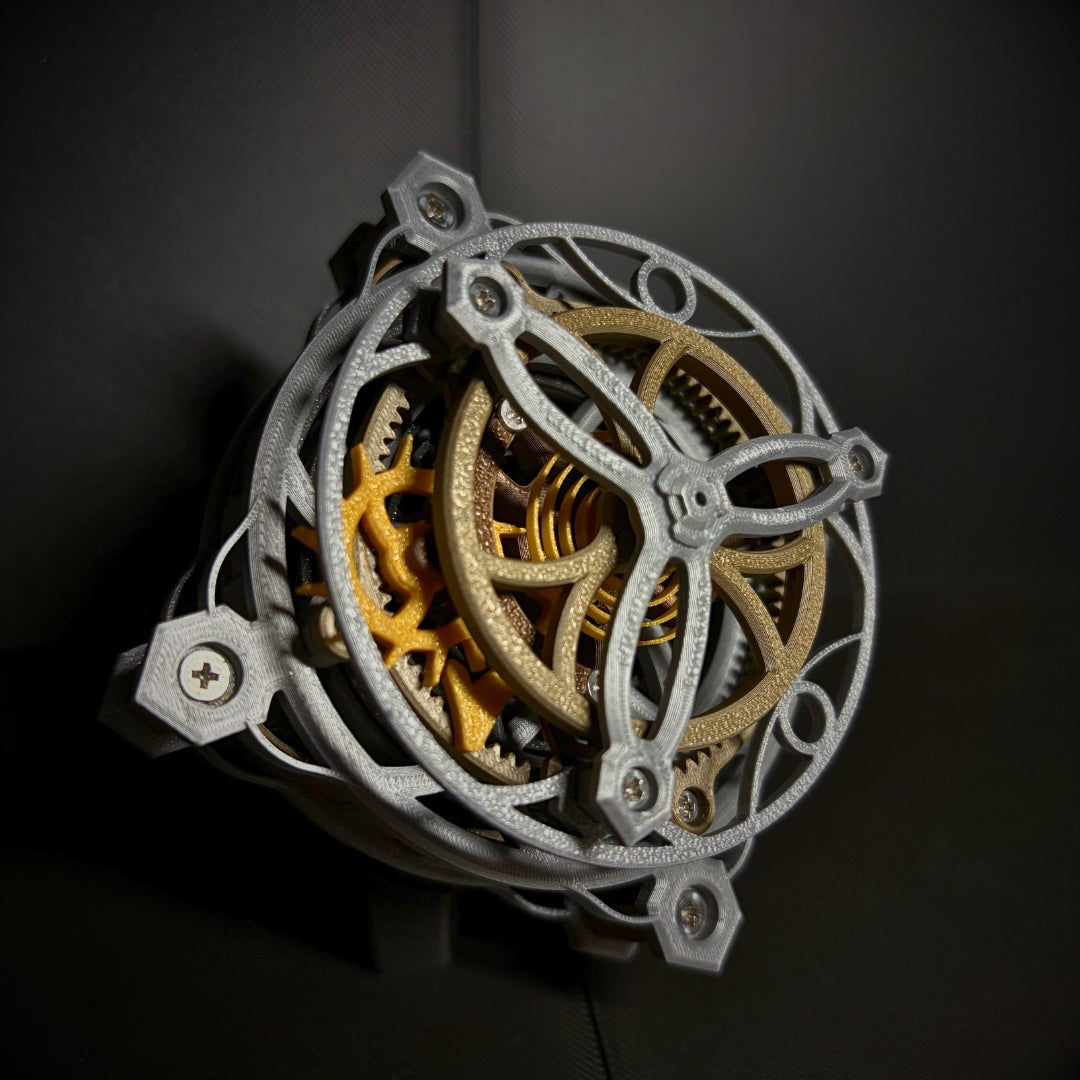
Mechanica uses precision 3D-printed components fastened with metal screws. The result is light enough for the mainspring to drive while retaining the visual detail of an exposed mechanical assembly. Each piece is hand-assembled and tested before leaving the workshop.
8. Choose an aesthetic that belongs in your space
A desk object becomes part of its surroundings.
A bright novelty item may feel out of place in a restrained office. A carefully finished kinetic sculpture can sit naturally beside books, instruments, watches, or design objects.
Look at the colours and materials already present on your desk. Cool silver, dark neutrals, blue accents, and warm metallic tones tend to work well with modern interiors. More importantly, choose something that reflects what you already appreciate.
For a watch enthusiast, an exposed tourbillon has a natural visual language. It speaks in bridges, wheels, pivots, springs, and controlled rotation.
Explore the available Mechanica collections, including single-axis tourbillons and bi-axis tourbillons.
9. Check how it is made
Production method matters when you are buying a collectible object.
Was the piece mass-produced? Is it assembled by hand? Is every unit tested, or is quality left to the factory line?
Mechanica pieces are made to order in Singapore. Components are assembled, tuned, and tested individually for winding, escapement, and rotation. Production remains intentionally small-batch, with limited weekly output from the workshop.
That slower process gives each piece a clearer connection to the people who made it. It also creates an object with a little more presence than an anonymous desk accessory.
A tourbillon is an old expression of accumulated watchmaking ingenuity. Mechanica brings that principle into a present-day workspace : where the mechanism can be seen without a loupe.
10. Think about support, warranty, and long-term use
Mechanical objects deserve practical consideration.
Find out how to care for the piece, whether replacement or repair support is available, and what happens if the mechanism arrives damaged or develops a fault.
Mechanica includes a 30-day warranty. If a piece arrives damaged or develops a mechanical fault within that period, it will be repaired or replaced at no charge, subject to the warranty terms.
Routine maintenance is not required. Keep the mechanism clean, wind it gently, and avoid unnecessary disassembly. A short care guide is also available through Mechanica Support, with instructions for winding, positioning, and troubleshooting.
For further details on shipping, returns, and warranty coverage, visit the FAQ.
A better kind of desk object
The best luxury desk objects are not loud status symbols. They are objects you notice again and again.
A good one gives your hands something precise to do. It gives your eyes a graceful sequence to follow. It adds character to a workspace without asking for attention every minute.
Mechanica is made for that quieter kind of appreciation.
The exposed escapement moves. The spring releases its stored energy. The tourbillon cage begins its slow procession.
Wind it. Watch it. Hear it.
Then leave it on your desk, ready for the next moment of curiosity.