

Why Everyone Is Talking About the Tourbillon in 2026 (And You Should Too)
A tourbillon is one of the most admired mechanisms in watchmaking.
It is also one of the hardest to appreciate.
Inside a wristwatch, the rotating cage may be only a few millimetres wide. You might catch it turning through an aperture at six o’clock. You might see it clearly under a loupe. Then the moment is gone.
In 2026, the tourbillon is having a wider moment.
Girard-Perregaux has brought one into a slim steel sports watch. Patek Philippe has placed grand complications and rare desk clocks at the centre of its Watch Art Grand Exhibition in Milan. And collectors are having a more open conversation about who gets to experience fine mechanical watchmaking.
The complication remains rare. The fascination is becoming easier to share.
A tourbillon in the spotlight
The most talked-about new example is the Girard-Perregaux Laureato Fifty Tourbillon Micro-Rotor 39 mm.
It combines a tourbillon with an automatic micro-rotor in a 39 mm stainless-steel case. The case is only 10 mm thick. That is a considerable achievement for a self-winding tourbillon.
The watch is powered by Girard-Perregaux’s in-house GP8410 calibre. It runs at 3 Hz, contains 207 components, and offers a 72-hour power reserve. The movement can be viewed through a sapphire caseback, where the platinum and pink-gold micro-rotor sits among the decorated bridges.
There is also a strong visual language.
The watch brings together five Girard-Perregaux signatures: the Laureato’s integrated architecture, arrow-shaped bridges, a lyre-shaped tourbillon cage, Clous de Paris detailing, and Grand Feu enamel on one version of the dial.

The price is listed at US$95,600.
That is still a serious luxury watch. “Accessible” is a relative word here. But within the world of high horology, a steel, automatic tourbillon below the usual six-figure threshold changes the conversation.
It places the tourbillon in a familiar sports-watch format. It makes the complication part of a permanent collection rather than an isolated exercise in precious metal.
That matters.
Grand complications move beyond the wrist
The other major 2026 moment is taking place in Milan.
Patek Philippe’s Watch Art Grand Exhibition Milan 2026 runs from 2 to 18 October at CityOval. Admission is free with registration.
The exhibition brings together more than 500 watches, movements, and objects across roughly 2,900 square metres and 15 themed areas. It includes historic pieces, current complications, watchmakers’ demonstrations, and a collection of Rare Handcrafts.
The display is not limited to wristwatches.
Rare desk and table clocks are part of the story. These objects show how watchmaking can occupy a room, not only a wrist. They use enamel, engraving, marquetry, guilloché, and other traditional crafts to turn timekeeping into something closer to sculpture.
This is an important shift in emphasis.
A grand complication can be technical. It can also be visual. It can be architectural. When a movement is placed in a desk clock or displayed as an object, the mechanism has more space to be studied.
You do not need to wear it to appreciate it.
Why the tourbillon still holds attention
The original tourbillon was patented by Abraham-Louis Breguet in 1801. Its rotating cage was designed to help reduce the effect of gravity on the regulating parts of a pocket watch.
Modern wristwatches have changed the problem.
A tourbillon is no longer necessary for most people to own an accurate watch. Quartz movements and modern mechanical calibres can deliver excellent everyday performance without one. The tourbillon has become something else as well: a concentrated demonstration of movement design, construction, and finishing.
It turns regulation into theatre.
The balance wheel oscillates. The escapement releases energy. The cage rotates around it. A small system performs a slow, graceful circuit while the rest of the movement continues working beneath.
That is why watch lovers continue to look.
A tourbillon gives the eye a point of focus. It makes the invisible flow of mechanical energy easier to imagine.
The difficulty is scale.
The scale problem
On the wrist, a tourbillon is an intimate detail.
At its best, it rewards close attention. You tilt the watch towards the light. You follow the cage. You look for the balance wheel moving inside it.
But the mechanism remains small.
Most people have never seen a tourbillon at a size they can comfortably observe. They have seen photographs, videos, and watch-show displays. They have not necessarily held one in the hand, wound it, and watched the power move through the system from a few inches away.
That changes the experience.
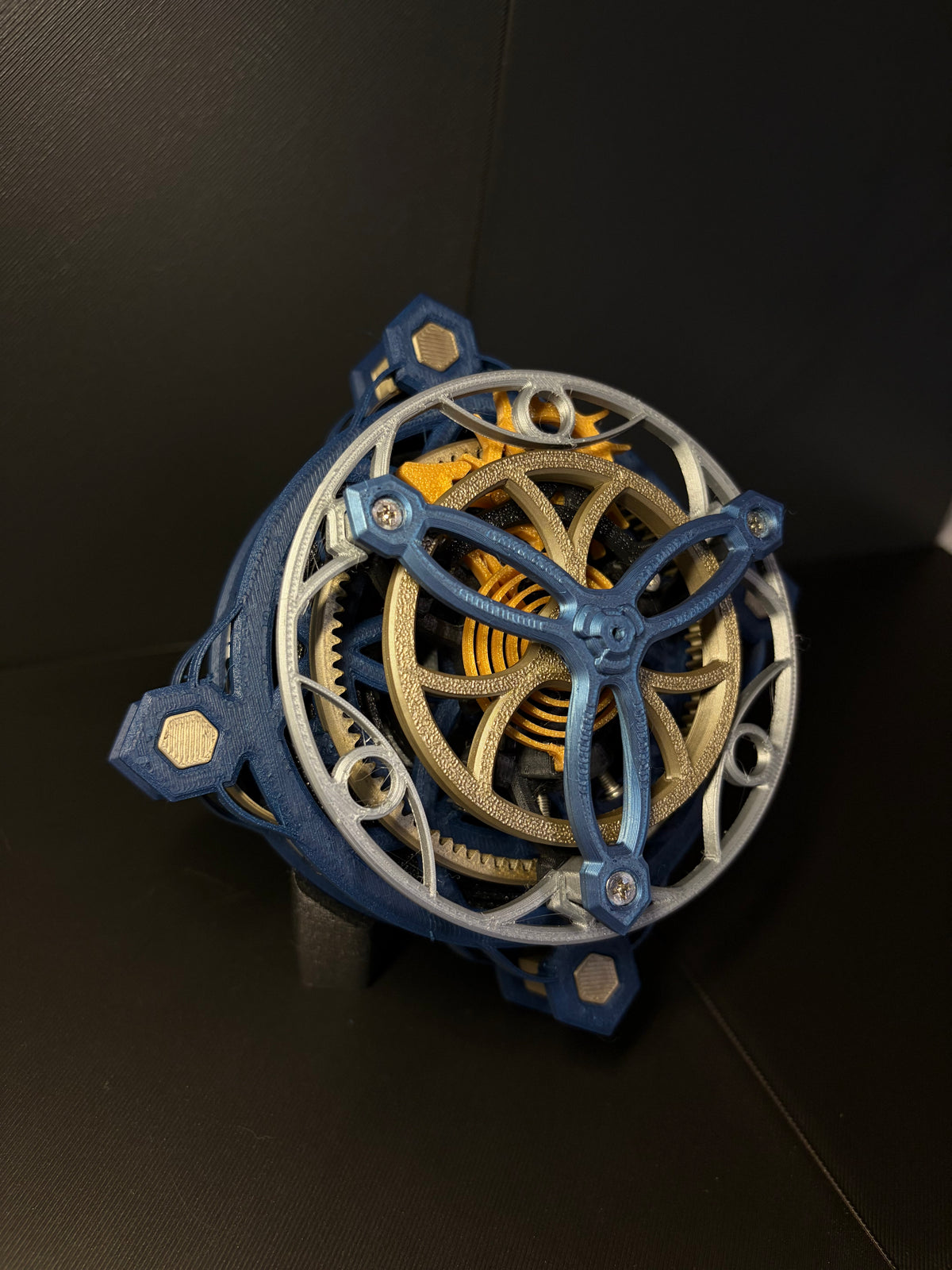
Larger scale does not make a palm-sized mechanism a wristwatch. It serves a different purpose. A watch movement is designed to keep time inside a compact case. A desk object is designed to reveal the movement.
You can see the cage.
You can follow the spring tension.
You can watch the escapement release stored energy.
The mechanism becomes less like a hidden component and more like a small piece of mechanical art.
A tourbillon for the desk
This is where Mechanica begins.
We recreated the tourbillon at the size of a palm: large enough to hold, wind, and admire. The Mechanica Tourbillon uses a genuine flying-tourbillon layout, with the rotating cage supported from a single centre post below.
It does not tell time.
It is built to show what the mechanism is doing.
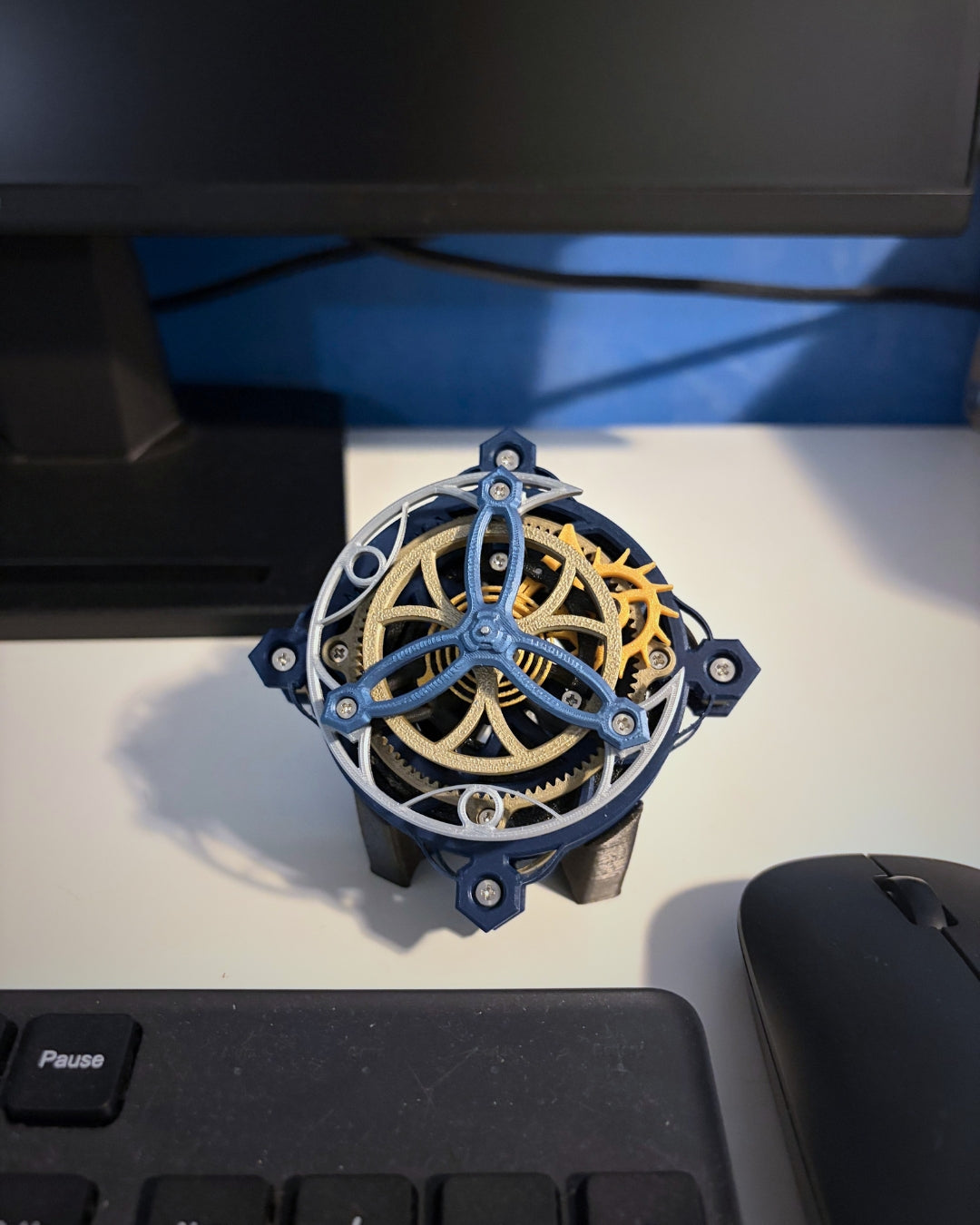
Wind it by hand and the mainspring stores the energy. The escapement releases it in controlled steps. The cage begins to rotate. The object produces the quiet ticking and faint mechanical sounds that watch collectors recognise immediately.
No electronics.
No batteries.
No motors.
The Compact Edition runs for more than 10 minutes on a single wind, depending on the selected power-reserve configuration. The Tourbillon Orbit adds a second axis of rotation, creating a more complex display of movement.
Both are desk objects first. They belong beside a watch box, on a writing desk, or wherever you keep the things you like to study.
More accessible does not mean less serious
The 2026 tourbillon conversation is not only about price.
It is about access.
A US$95,600 wristwatch makes a tourbillon more approachable within haute horlogerie. A palm-sized wind-up desk object makes its movement easier to see and understand. These are different forms of access, but they share the same direction.
The mechanism is moving closer to the viewer.
That matters because mechanical watchmaking is not only about ownership. It is about observation. The satisfaction comes from seeing a system work: a spring unwinding, gears transmitting force, an escapement releasing energy, and a cage turning with measured calm.
You do not need to be a seasoned collector to find that compelling.
You only need enough time to watch.
Hand-assembled in Singapore
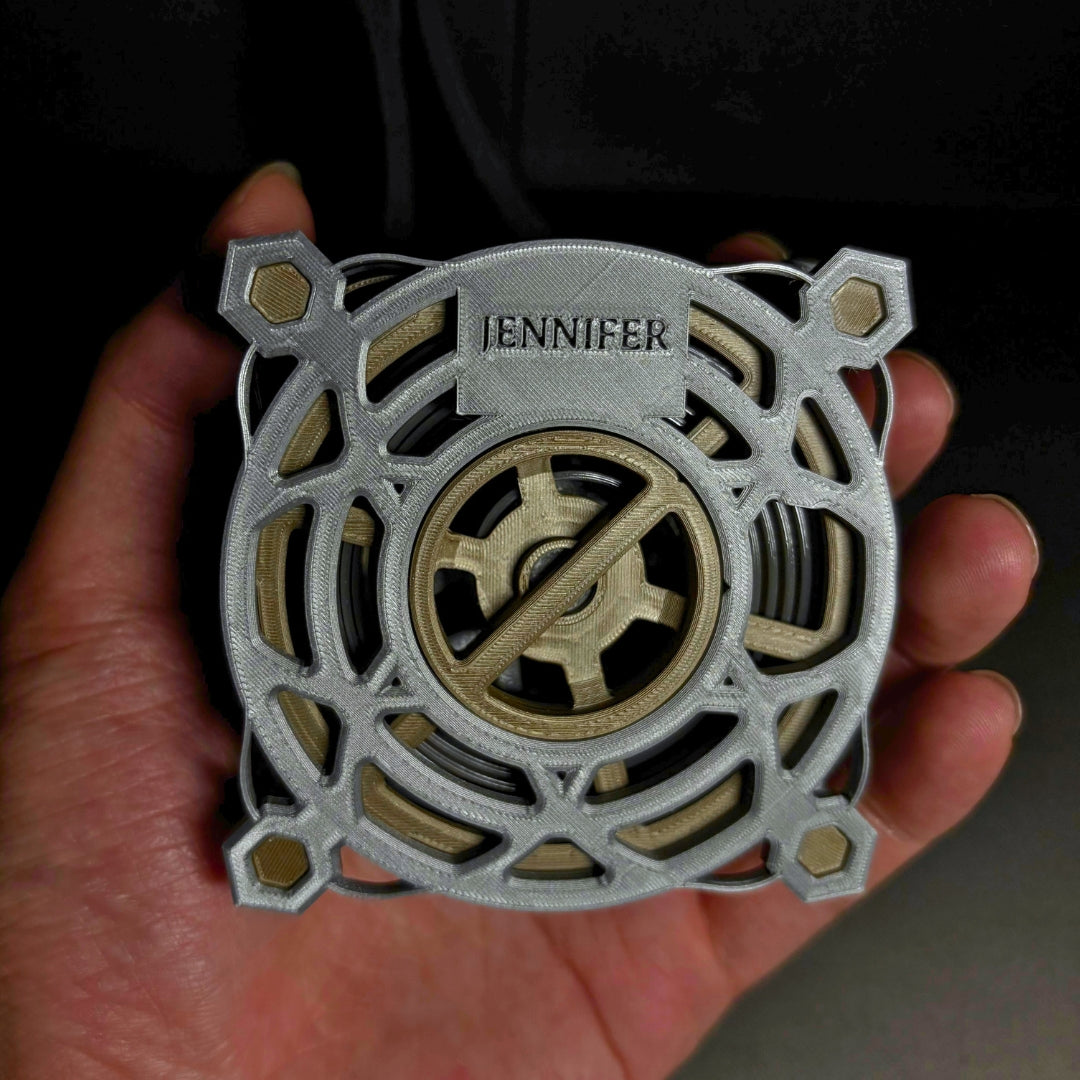
Every Mechanica is hand-assembled and tested in Singapore.
Production remains intentionally small-batch. The Tourbillon Orbit is limited to two units per week, while the single-axis Mechanica is limited to four per week. Each piece is individually checked for winding, escapement, and rotation before it leaves the workshop.
That process keeps the object close to its mechanical purpose.
It is not a powered screen. It is not a decorative imitation of movement. It is a wind-up piece of desk art that asks for your hand, your attention, and a few quiet minutes.
Mechanica ships worldwide. Every piece includes a 30-day warranty covering damage on arrival or mechanical faults.
The tourbillon is worth seeing
The tourbillon has always been made to be admired.
In 2026, it is appearing in more places: on a contemporary steel sports watch, inside a major watch exhibition, in rare desk clocks, and in palm-sized mechanical art.
The principle remains the same.
Stored energy becomes controlled motion. Small parts work together. A rotating cage turns a technical solution into something beautiful to watch.
Most people have only seen that movement at a distance.
Mechanica brings it closer.
Explore the Mechanica collection and hold, wind, and admire a tourbillon built for the desk.