

What Is a Tourbillon? The Spinning Mechanism Behind the World's Most Coveted Watches
A tourbillon is one of the most recognisable complications in fine watchmaking.
It is also one of the easiest to misunderstand.
At first glance, it looks like a small cage spinning inside the watch. That is exactly what it is. But the rotating motion has a serious purpose. It was designed to reduce the effect of gravity on a mechanical watch’s timekeeping parts.
Today, a tourbillon watch is admired not only for its function, but for the skill required to build it. The mechanism turns a hidden technical problem into something visible, graceful, and quietly mesmerising.
What is a tourbillon?
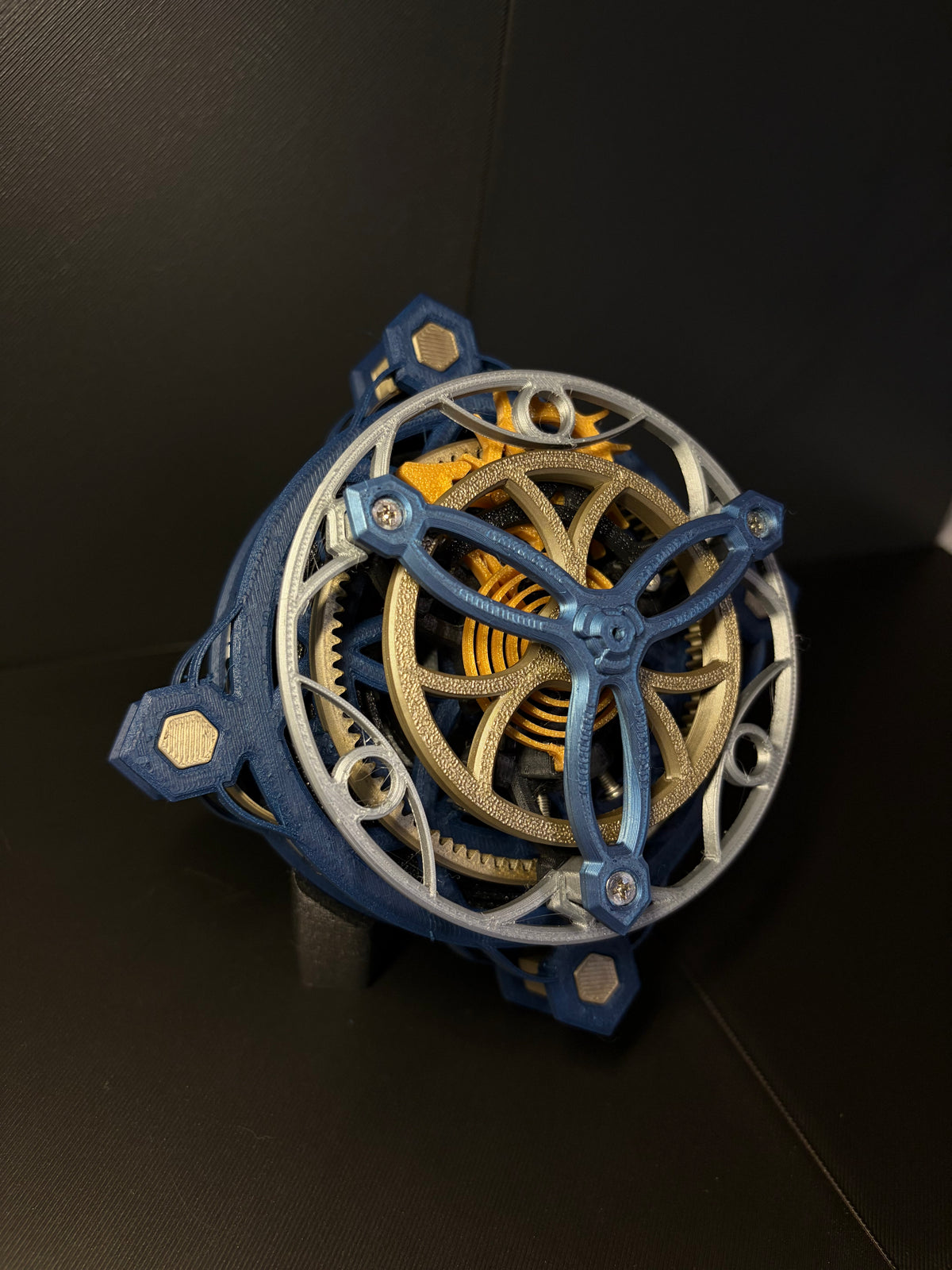
A tourbillon is a rotating cage that holds the watch’s regulating parts.
Inside the cage are the:
- Balance wheel
- Hairspring
- Escapement
- Pallet fork
- Escape wheel
These parts control the release of energy and regulate the speed of a mechanical watch.
In a conventional mechanical movement, the balance wheel and escapement remain fixed in one position. In a tourbillon movement, they are placed inside a cage that rotates continuously, often completing one full revolution per minute.
The cage carries the regulating parts through different positions as it turns.
That movement is the heart of the tourbillon.
Why was the tourbillon invented?
Abraham-Louis Breguet patented the tourbillon in 1801.
At the time, accurate pocket watches were difficult to regulate. Pocket watches were commonly carried upright in a waistcoat pocket. They could remain in the same vertical position for long periods.
Gravity was always pulling on the balance wheel, hairspring, pivots, and other regulating parts in the same direction.
This created positional errors.
A watch might gain time in one position and lose time in another. The effect was small, but over the course of a day, it could affect accuracy.
Breguet’s solution was elegant:
If gravity cannot be removed, change the position of the regulating parts.
By placing them inside a rotating cage, the movement is exposed to different vertical positions during each revolution. Errors that occur in one position can partially balance errors that occur in another.
The tourbillon does not eliminate gravity. It averages its effects over time.
You can read more about the original invention in Breguet’s history of the 1801 tourbillon patent.
How does a tourbillon work?
The easiest way to understand a tourbillon is to first understand the basic flow of energy inside a mechanical watch.
1. The mainspring stores energy
When you wind a mechanical watch, you tighten the mainspring.
The spring stores potential energy. As it unwinds, it provides power to the movement.
2. The gear train transfers power
A series of gears carries that energy through the watch.
Each wheel turns at a different speed. Together, they deliver the correct power to the seconds, minutes, and hours hands.
3. The escapement releases energy
The mainspring cannot be allowed to unwind all at once.
The escapement releases the stored energy in small, measured steps. It works with the balance wheel and hairspring to create a regular rhythm.
The familiar ticking sound comes from this controlled release.
4. The tourbillon rotates the regulating system
In a tourbillon watch, the balance wheel and escapement sit inside a rotating cage.
The cage turns slowly, usually once per minute. As it rotates, the regulating parts move through different orientations relative to gravity.
One position may cause the watch to run slightly fast. Another may cause it to run slightly slow. Over time, the rotation helps average out these differences.
The principle is simple. The construction is not.
A tourbillon requires additional parts, precise tolerances, careful adjustment, and considerable skill to assemble and regulate.
Tourbillon facts
- Inventor: Abraham-Louis Breguet
- Patent date: 1801
- Primary purpose: Reduce positional timing errors caused by gravity
- Rotating component: The cage carrying the balance and escapement
- Typical rotation: One revolution per minute
- Category: Mechanical watch complication
Why do watch lovers obsess over tourbillons?
A tourbillon combines technical difficulty with visible movement.
Most of a mechanical watch’s work happens behind the dial or beneath the caseback. You may know that gears are turning, springs are releasing energy, and the balance wheel is oscillating. But you cannot always see those actions clearly.
A tourbillon brings part of that process to the front of the watch.
You see the cage turn.
You see the balance wheel beat.
You see the escapement release energy in small, precise steps.
It is a working demonstration of mechanical watchmaking. The movement is not simply decorative. It exists because the mechanism is performing a real function.
That combination is what makes a tourbillon so compelling to collectors. It is a complication you can understand with your eyes.
There is also a sense of scale. Watchmakers fit the tourbillon into a space only a few millimetres wide. Every bridge, pivot, spring, and wheel must work within tight physical limits.
The result is a small machine with remarkable visual presence.

Does a tourbillon make a modern watch more accurate?
Not necessarily.
The tourbillon was created for pocket watches, which often remained in a fixed vertical position. Wristwatches move naturally throughout the day. Their changing positions already help distribute the effects of gravity.
Modern manufacturing, improved materials, better lubrication, and careful regulation have also made high-quality mechanical watches more accurate.
For that reason, a tourbillon is not always a practical accuracy upgrade in a modern wristwatch.
Its value today is broader.
It represents watchmaking knowledge. It demonstrates control over a difficult mechanism. It gives collectors the pleasure of seeing an advanced movement at work.
In other words, a tourbillon watch is valued for both engineering and expression.
The original problem was accuracy. The lasting fascination is mechanical beauty.
For a specialist explanation of the mechanism and its place in horology, the Fondation Haute Horlogerie’s tourbillon encyclopedia is a useful reference.
Flying tourbillon and traditional tourbillon
Not every tourbillon is built in exactly the same way.
A traditional tourbillon cage is supported by bridges or structures above and below it. A flying tourbillon is supported from below by a single central post, without an upper bridge.
This gives the cage a more open appearance. From the front, it can look as though the mechanism is floating.
The flying layout is especially appealing when the tourbillon is designed to be observed. There is less structure blocking the view of the rotating cage and balance wheel.
It is a small change in architecture, but a significant one visually.
From the wrist to the desk
A tourbillon watch is made to be worn.
Its mechanism must be compact, light, and protected inside a case. You may catch a glimpse of the rotating cage through an opening in the dial, but the view is naturally limited by the watch’s scale.
Mechanica explores the same fascination from the opposite direction.
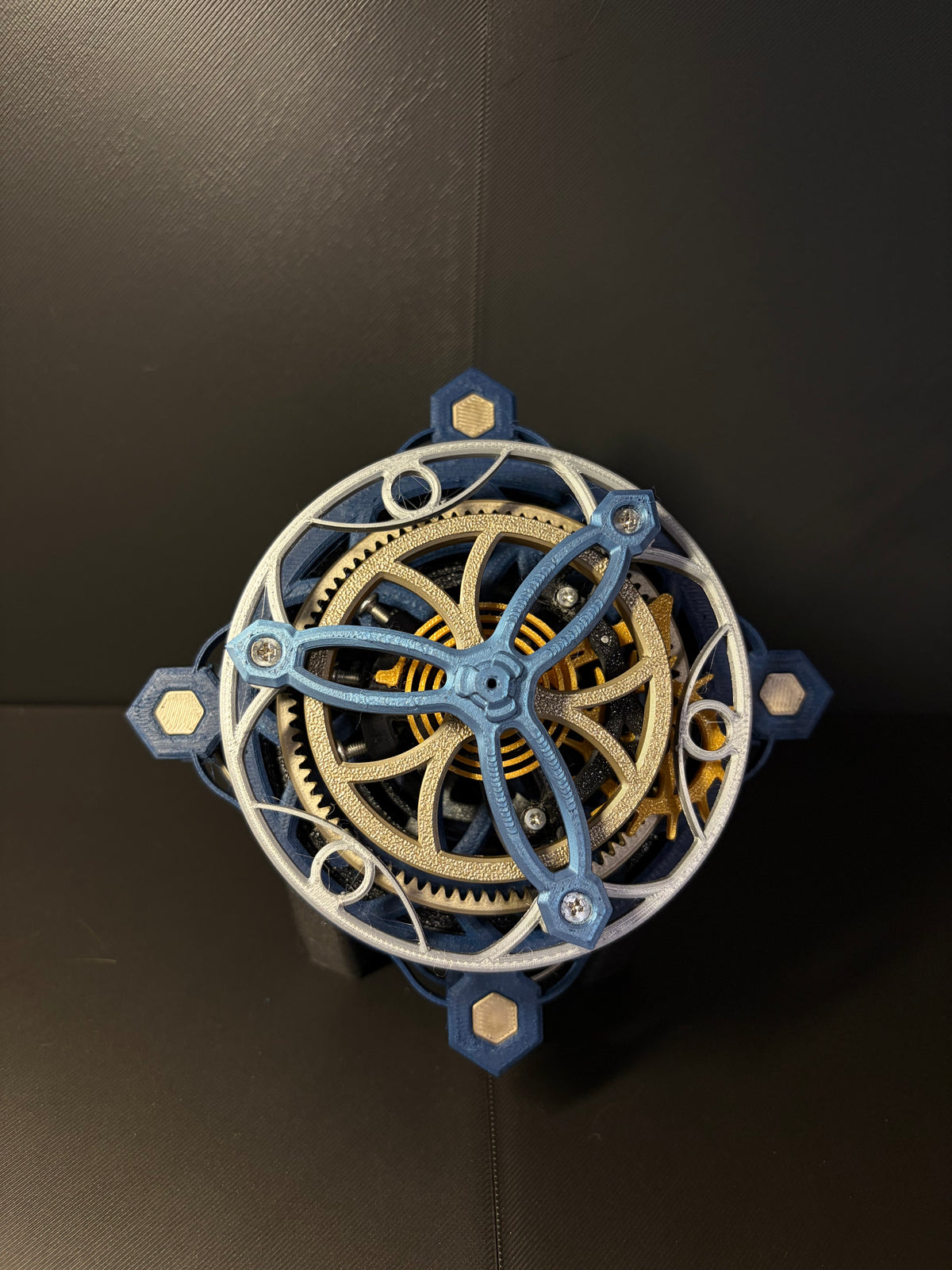
The tourbillon is recreated at palm size : large enough to hold, wind, and admire.
A tourbillon you can watch up close
Mechanica is not a timekeeping watch.
It is a spring-powered mechanical desk object built around the same tourbillon principle. The rotating cage and escapement are enlarged and exposed, so the movement can be followed without a loupe or magnifying glass.
Wind it by hand.
Watch the cage rotate.
Listen to the escapement work.
No electronics. No batteries. No motors.
Stored energy in the mainspring drives the mechanism. The escapement releases that energy in measured steps. The rotating cage carries the regulating parts through their graceful procession.
The experience is physical from beginning to end.
You feel the winding tension build. You hear the faint ticking. You watch the mechanism gradually use the energy you gave it.
That is part of the appeal of mechanical art. The object does not simply sit on a desk and perform by itself. It asks for a small moment of attention.
As one verified customer wrote:
“The tourbillon is one of the most visually interesting complications in watchmaking. Getting to see the mechanism work on an enlarged scale only makes it more so.”
Another described the experience this way:
“Watching a tourbillion work is always mesmerizing.. it's doubly nice when I don't have to see it thru a magnifying glass..”
Hand-assembled in Singapore
Every Mechanica is made to order, hand-assembled, and tested in Singapore.
Each piece is checked for winding, escapement, and rotation before it leaves the workshop. Production is intentionally limited, with only a small number completed each week.
The Mechanica Tourbillon Desk offers a 100 mm display format. The Compact Edition brings the same idea to a smaller footprint.
For collectors who want a more complex visual motion, the Tourbillon Orbit adds a second axis of rotation.
Each is designed for observation rather than timekeeping. Each gives the mechanism room to be seen.
A different way to appreciate the tourbillon
The tourbillon began as a solution to a precise problem in mechanical timekeeping.
More than two centuries later, it remains one of watchmaking’s most admired complications because it makes invisible work visible.
A tourbillon watch shows the discipline of stored energy, controlled release, and constant motion in a very small space.
Mechanica brings that experience closer.
You can hold it. Wind it. Watch it. Hear it.
The scale is different. The purpose is different. But the fascination remains the same ; a genuine mechanical system moving with quiet, timeless precision.
Explore the Mechanica collection. Each piece ships worldwide from Singapore and includes a 30-day warranty.