

How to Integrate Mechanical Art With Your Watch Collection (Without Buying Another Watch)
A watch collection can feel complete. The pleasure of looking closer at how a watch works does not have to end there.
On the wrist, even a beautifully finished movement is small. Its escapement and spring are only a few millimetres across, often seen through a display back or with a loupe. A wind-up desk object brings that mechanical language into the room at a scale you can watch without leaning in.
It does not replace a watch. It gives the collection another way to be enjoyed.
A companion, not another timepiece
The best addition to a collection does not need to compete with the watches already in it. A piece of mechanical art can sit alongside them as an object for observation: one that shows a spring releasing its stored energy, gears turning, and an escapement ticking through its cycle.
It is not a watch and does not keep time. There is no dial to read or wrist to wear it on. The appeal is different: wind it, watch the mechanism move, and notice details that are easy to miss at wrist scale.
That distinction matters. The object complements the collection because it shares an interest in mechanical watchmaking without asking to be worn or compared by reference, complication, or case size.
Give both objects room
A display works best when each piece has a clear place. Put a desk object beside a watch box, on a shelf near a favourite watch, or on a separate part of the desk where its movement can catch your eye. The watch remains the centre of its own display. The mechanical art adds a point of focus nearby.
Think in terms of contrast, not matching. A row of watches can have a different visual rhythm from an exposed mechanism. A dark base can make the movement stand out; a nearby watch can offer the familiar contrast of case, dial, and strap. Leave enough space between the objects so neither looks crowded, and so watch cases and bracelets do not rub against one another.
Height matters, too. A low watch tray and a raised display stand create a natural difference in perspective. Position the moving mechanism where you can see it while seated, without blocking the watches behind it. A little breathing room makes the arrangement feel considered rather than busy.
See the mechanics at a new scale
A mechanical watch turns stored spring energy into regulated movement. The gear train transmits that energy; the escapement releases it in measured steps. In a wristwatch, these parts are compact by necessity. On a desk, their motion is easier to follow.
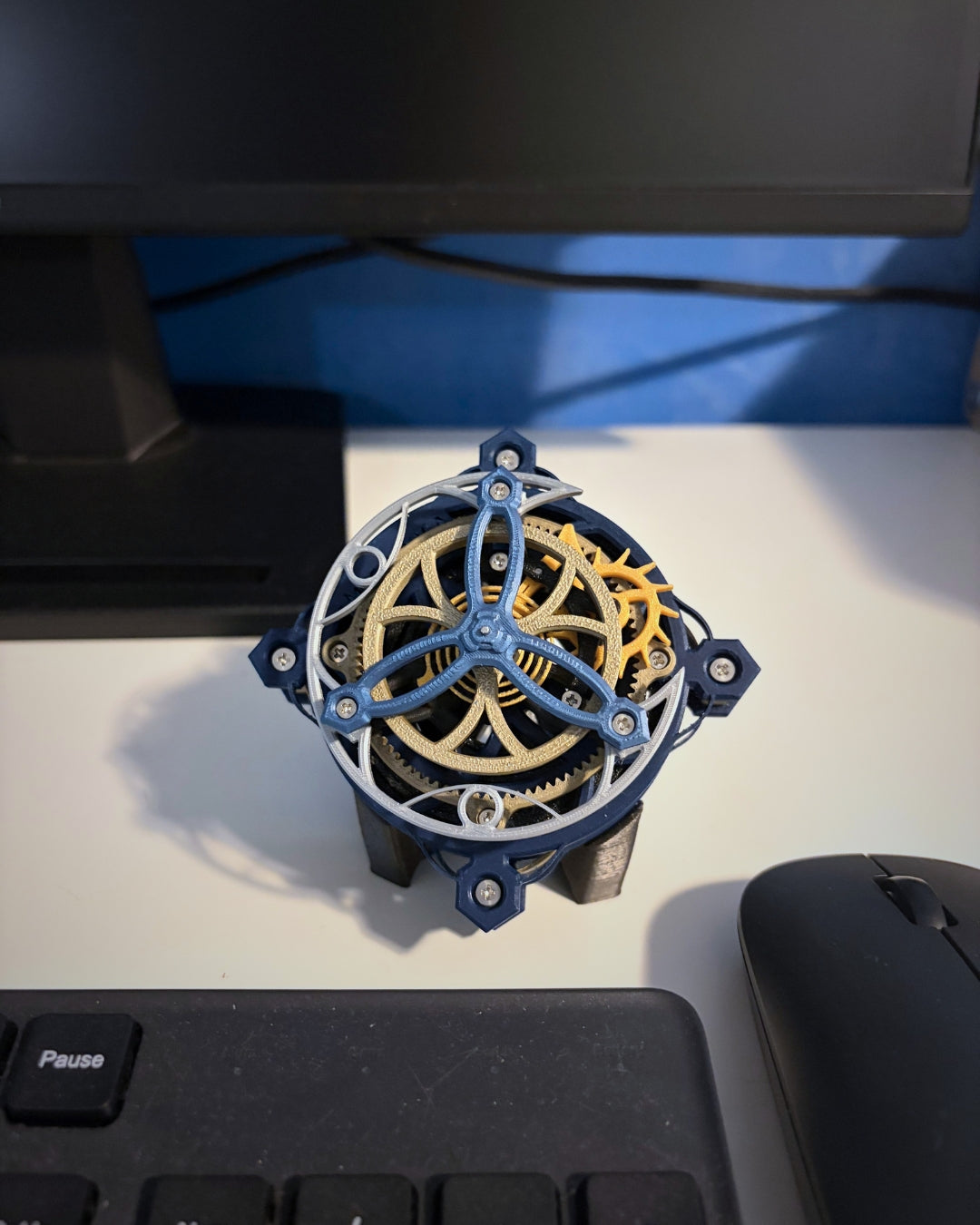
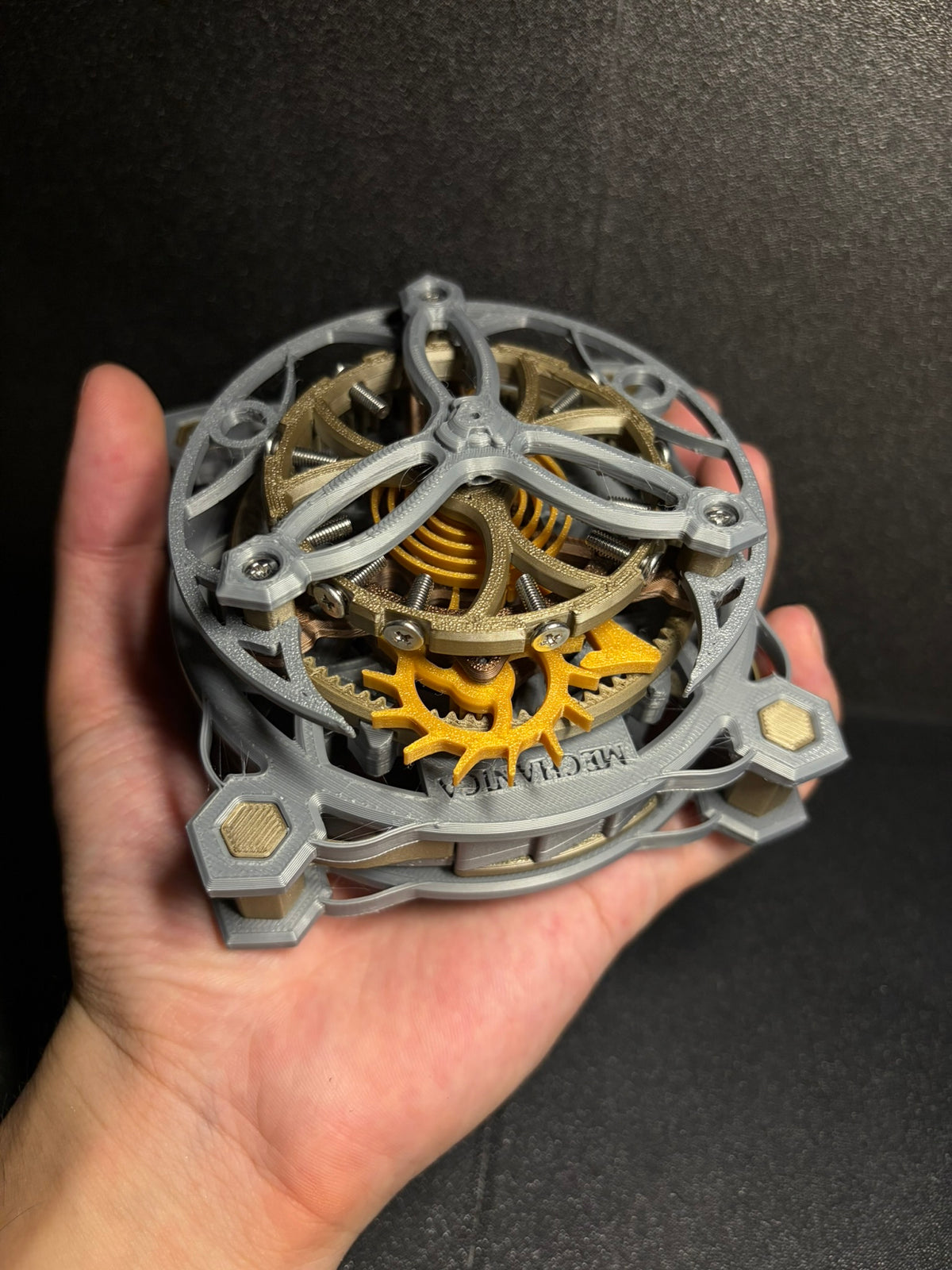
Mechanica’s pieces use a genuine flying-tourbillon layout. The rotating cage is supported from below, without an upper bridge. The objects are spring-powered and built for viewing, not timekeeping. They make the movement visible at palm scale, but they are not a watch movement removed from a watch.
That change of scale can deepen appreciation for the watches you already own. After watching a spring unwind and the escapement work in the open, details you have seen through a caseback may feel more legible. It gives you a new way to look at the engineering behind the watch on your wrist.
Choose a scale that suits the space
The right piece is the one that fits naturally into the way you display and use your collection. The Compact Edition takes up little room beside a watch box. The larger Desk Edition gives the mechanism more presence on a work surface. The Tourbillon Orbit adds a bi-axial arrangement, with two axes moving independently.
| Edition | Dimensions | Runtime per wind | Price |
|---|---|---|---|
| Compact Edition | 75 × 75 × 40 mm | Up to 10 minutes, depending on configuration | USD 280 |
| Desk Edition | 100 × 100 × 55 mm | Up to 10 minutes, depending on configuration | USD 360 |
| Tourbillon Orbit | 120 × 90 mm base, 120 mm high | Up to 10 minutes; up to 15 minutes in the Reserve configuration | USD 650 (USD 850 with Reserve) |
The Orbit’s two independently moving axes give the display a different character from the single-axis pieces. Compare the Orbit with the Compact Edition and the single-axis collection to see how each might sit in your space.
Make winding part of the display
A watch collection often has its own rituals: choosing a watch, setting it, winding it, or checking its movement through the caseback. A spring-powered desk object offers another small ritual. You wind it by hand, then watch the mechanism run.
No electronics. No batteries. No motors.
Runtime is up to 10 minutes per wind, depending on the edition and power-reserve configuration. The Orbit’s Reserve configuration runs for up to 15 minutes. The interval is long enough to pause over the movement, but short enough to make winding part of the experience rather than leave the object running unnoticed all day.
It can be a quiet moment between tasks. Or simply something to watch while you sit with the collection.
A thoughtful choice when the watch box is full
For a collector who already owns the watches they want, another watch can be a difficult choice to get right. A mechanical desk object approaches the same interest from another direction. It speaks to the fascination with gears, escapements, and spring power without trying to fill a gap in the watch box.
That can make it a personal addition to your own display, or a considered present for someone whose collection is already well established. The point is not to add another reference. It is to bring the mechanics they appreciate into view.
Made for close observation
Mechanica pieces are hand-assembled and tested in Singapore, and produced in small batches. Production is limited to two Orbit units per week and four single-axis Mechanica units per week.
Early customers give Mechanica a 5.0 average rating. Collectors have welcomed the pieces in Singapore, Germany, the United States, Brazil, Indonesia, and the United Kingdom. Each comes with a 30-day warranty covering damage on arrival or mechanical faults.
The result is a desk object that belongs naturally beside a watch collection: not another timepiece to acquire, but another way to spend time with the mechanics you already admire. A watch on the wrist. A movement on the desk. Both worth a closer look.