

A Real Watch Movement, Scaled Up for Your Desk
A mechanical watch movement is remarkable because it does so much in so little space.
Inside a case only a few millimetres thick, a mainspring stores energy. Gears transmit it. An escapement releases it in measured steps. A balance wheel oscillates back and forth. Together, these parts create a living mechanical system that can run for hours on a single winding.
There is only one problem.
It is difficult to see.
The most beautiful parts are often hidden behind a dial, beneath a caseback, or reduced to a blur of tiny wheels. A loupe reveals the detail, but only for a moment. You cannot easily hold the movement in your hand, follow the power as it travels, or watch the escapement work from across your desk.
Mechanica explores the same fascination at a different scale.
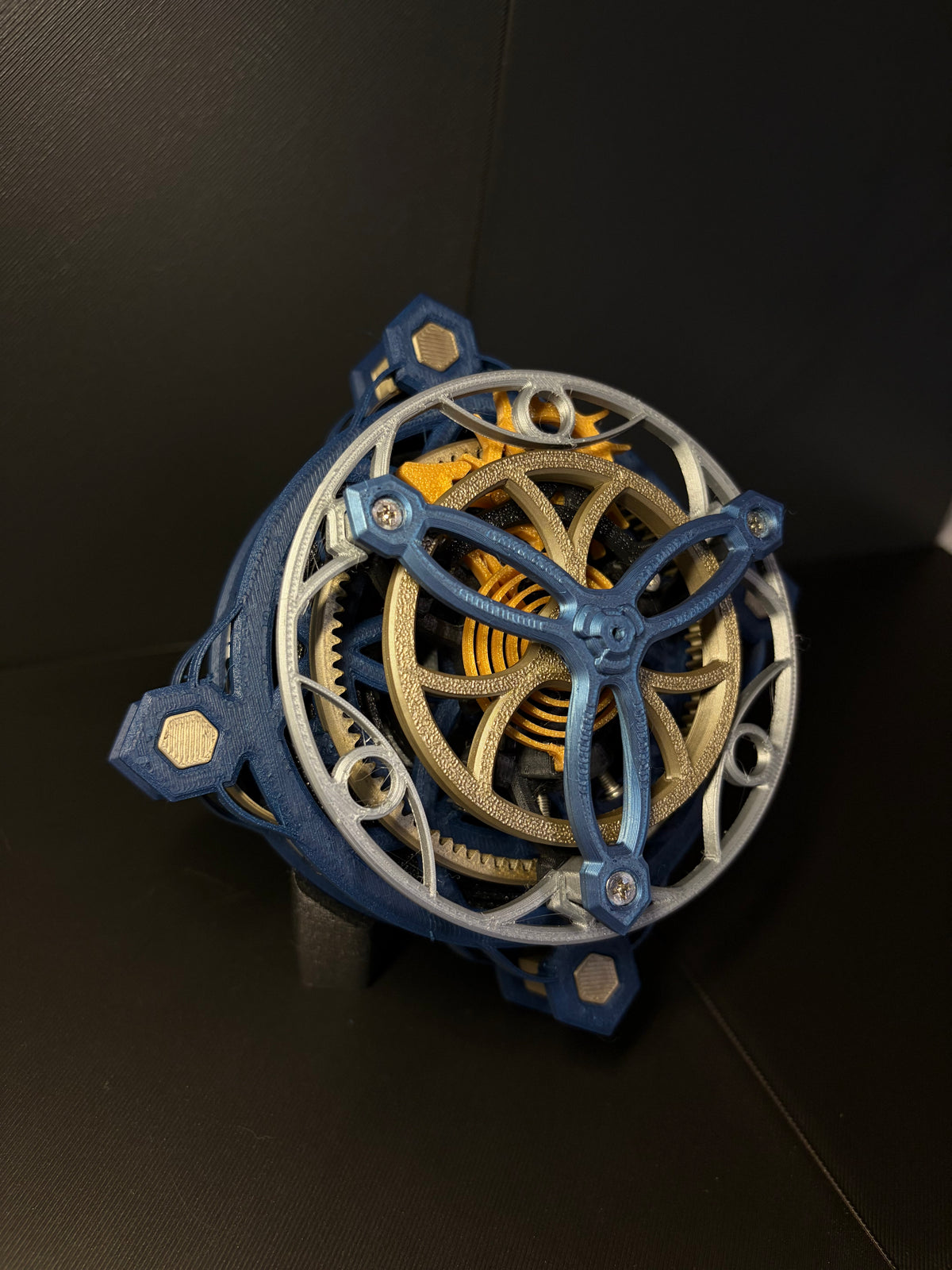
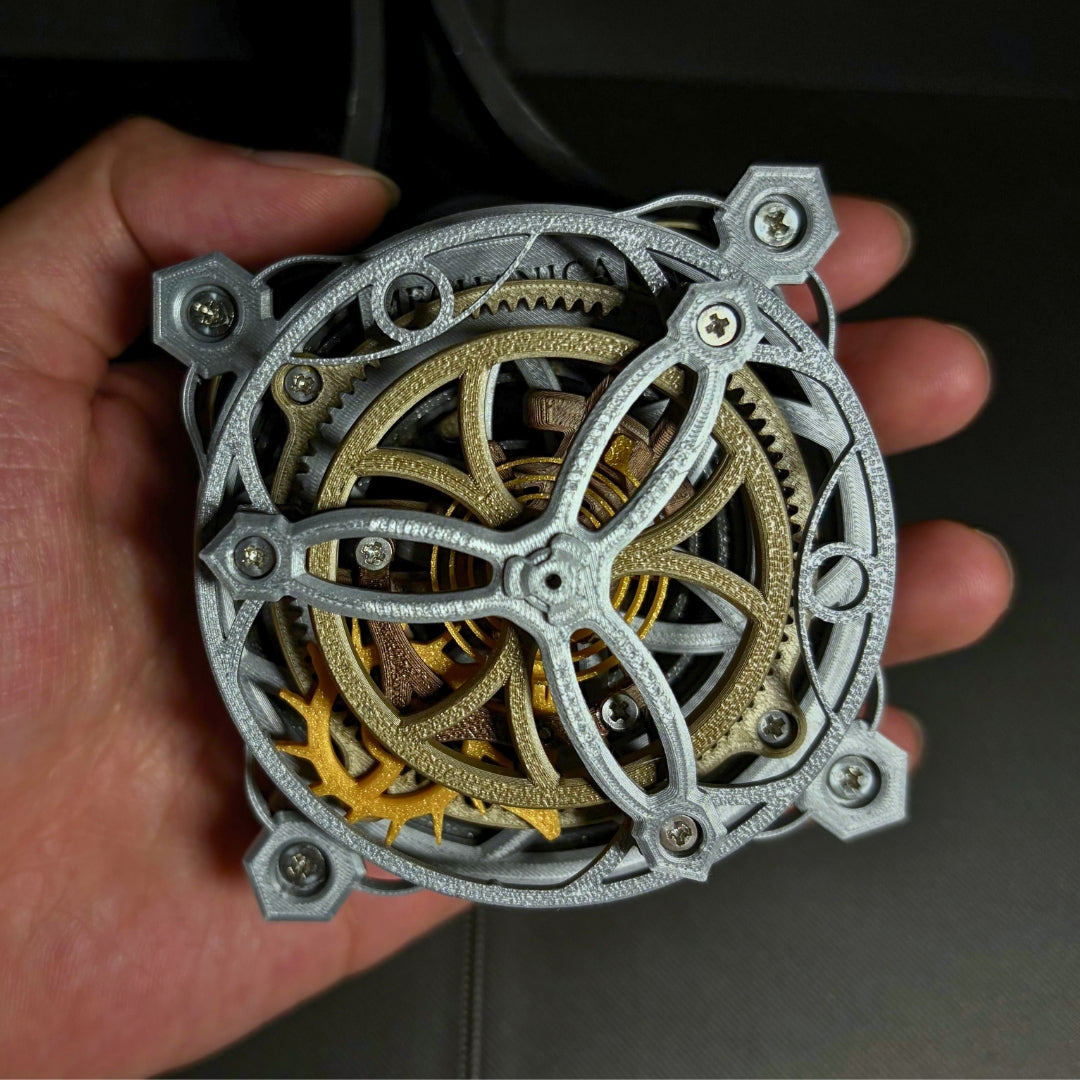
It recreates a genuine flying tourbillon layout in a palm-sized form : large enough to hold, wind, and admire. It does not tell time. It gives the movement room to be seen.
Same soul. Different scale.
A traditional mechanical watch is designed around compactness and precision.
Every component must fit within a tightly constrained space. The gear train, balance, hairspring, and escapement are arranged with extraordinary efficiency. The result is a machine that can disappear beneath a watch dial while continuing to perform its work.
A desk version has a different purpose.
It is designed for observation. The mechanism is enlarged and exposed. The rotating cage is easy to follow. The hairspring is visible. The winding action becomes part of the experience rather than something hidden at the edge of a watch case.
This is the central difference between a mechanical watch and Mechanica:
- A watch movement is built to keep time.
- A Mechanica is built to reveal how mechanical movement works.
- Both depend on stored spring energy, controlled release, and carefully arranged moving parts.
The scale changes. The fascination remains.
What happens inside a mechanical watch?
A mechanical watch begins with stored energy.
When you wind the crown, you tighten the mainspring inside its barrel. The spring wants to unwind, but it cannot release all its energy at once. If it did, the hands would spin rapidly and the watch would stop almost immediately.
The gear train controls the flow.
A series of wheels and pinions transfers power through the movement. Each wheel turns at a different speed. The arrangement converts the mainspring’s force into the measured rotations needed to drive the seconds, minutes, and hours.
Then comes the escapement.
The escapement acts as a release system. It allows the gear train to advance in small, regular steps instead of turning freely. The balance wheel and hairspring provide the repeating rhythm. The pallet fork and escape wheel pass energy through the system one release at a time.
That familiar ticking sound is the audible trace of this process.
As Grand Seiko explains in its overview of mechanical movements, the mainspring, gear train, escape wheel, pallet fork, balance, and hairspring work together to regulate the release of energy. The principle has remained remarkably durable across generations of watchmaking.
Mechanica brings that principle closer to the eye.
The tourbillon, made visible
A tourbillon places the escapement inside a rotating cage.
In a wristwatch, the cage is usually only a few millimetres wide. It rotates slowly while the balance wheel oscillates inside it. The effect is subtle when viewed on the wrist. It becomes much more immediate when the mechanism is enlarged.
You can see the cage make its graceful procession.
You can watch the balance move.
You can follow the escapement as it releases the stored energy from the mainspring.
Mechanica uses a genuine flying tourbillon layout. The rotating cage is supported from a single centre post below, with no upper bridge. This creates an open view of the mechanism and gives the tourbillon its floating appearance.
It is not a timekeeper. It is not intended to replace the movement inside your watch.
It is a desk object for people who enjoy what the movement is doing.
Wind it. Watch it. Hear it.
A quartz object can sit on a desk and run indefinitely. A powered display can repeat the same movement at the press of a button.
Mechanica is different.
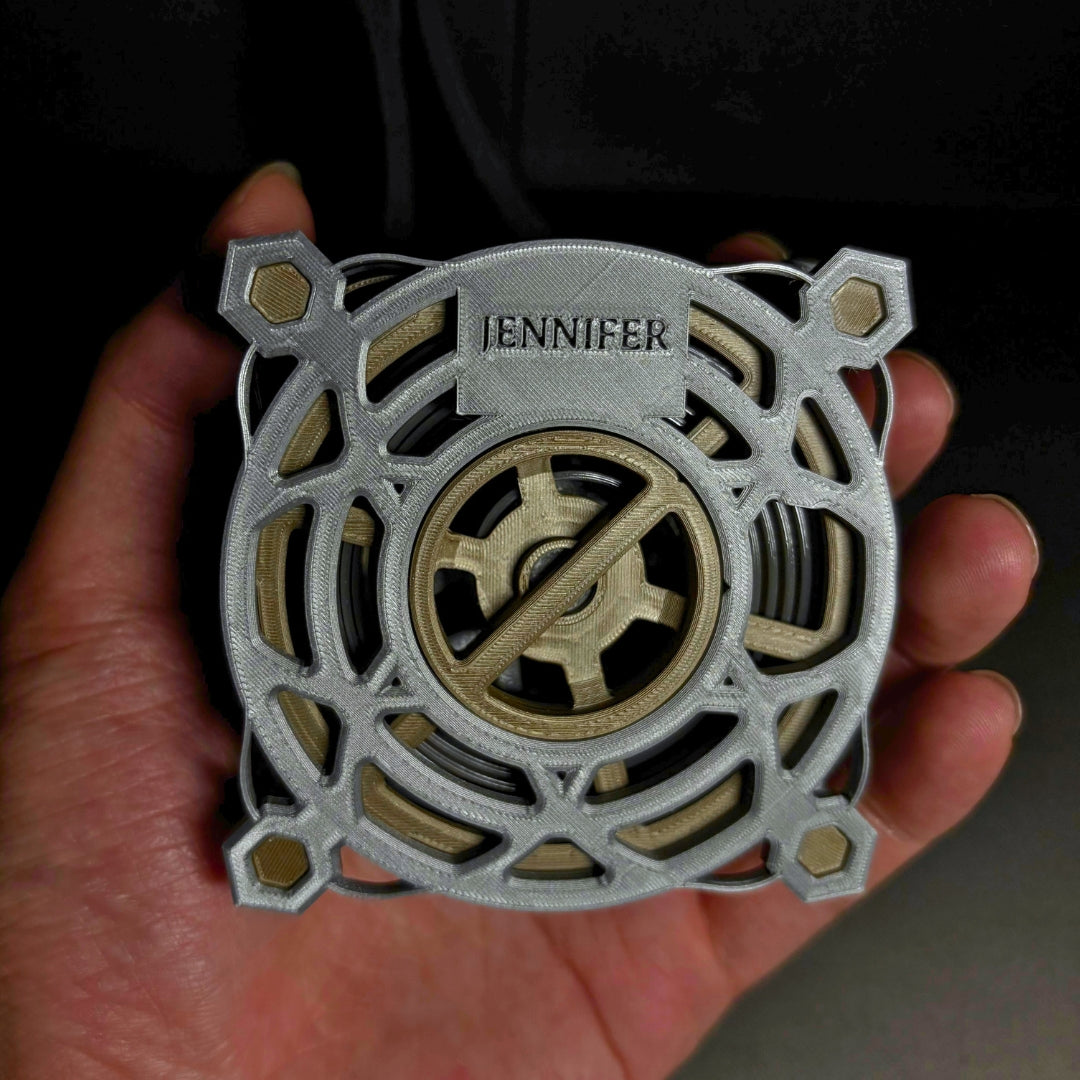
You wind it by hand. The mainspring stores the energy. The escapement releases it. The cage rotates until the stored power is spent.
No electronics.
No batteries.
No motors.
The act of winding gives you a physical connection to the mechanism. You feel the spring tension build through the winding key. Then you release the mechanism and listen.
There is a soft mechanical rhythm. A faint ticking. The small sounds of gears engaging and energy moving through the system.
This is mechanical ASMR in its most direct form. Not a soundtrack added afterwards. Not an imitation of machinery. The sound comes from the object itself.
The runtime depends on the model and power-reserve option. The Mechanica Tourbillon Desk runs for up to 90 seconds in its Original configuration or up to 10 minutes with the Reserve option. The Compact Edition offers up to three minutes in its Original configuration.
The duration is long enough to watch the mechanism settle into its rhythm. Short enough to invite another winding.
Why make a watch movement larger?
Simply enlarging every part of a wristwatch would not create a practical timepiece.
Scale changes the physics. Larger components carry more mass. Friction becomes more significant. A balance wheel designed for a wristwatch would not oscillate at the same frequency when enlarged. The spring, gear ratios, and supporting structure all need to be considered again.
That is why a desk version must have a different purpose.
Mechanica does not pretend that a palm-sized object is a wristwatch without a case. It takes the visual and mechanical language of watchmaking and adapts it for close observation.
The result is more like a movement displayed in its most honest form.
You do not need a loupe.
You do not need to remove a caseback.
You do not need to wait for the right angle of light.
The escapement is in front of you.
A natural desk centerpiece for watch lovers
A mechanical watch usually stays close to the body. It travels with you, marks the day, and reveals its details when you choose to look down at the wrist.
Mechanica brings that relationship into the room.
Place it beside a watch box, on a writing desk, or near the books and tools that reflect your interests. It becomes desk art with a practical presence. Not a static ornament. Not a decorative object pretending to be useful.
It asks for a small amount of attention.
Wind it before a meeting. Watch the cage while you think. Listen to the rhythm while reading. Let your eyes follow one wheel, then another, until the mechanism becomes quietly absorbing.
This is part of what early customers notice.
“It gives off a satisfying ticking sound when activated. It is mesmerising to look at the hairspring while the cage makes its graceful procession. A mini masterpiece!”
: J., verified customer
Another collector described it simply:
“Watching a tourbillion work is always mesmerizing.. it's doubly nice when I don't have to see it thru a magnifying glass..”
: C.H., verified customer
The appeal is not loud. It is the satisfaction of seeing a complicated system behave exactly as it should.
Made in small batches in Singapore
Every Mechanica is made to order, hand-assembled, and tested by our team in Singapore.
Before it leaves the workshop, each piece is checked for winding, escapement, and rotation. The mechanism is tested as a working object, not only inspected as a finished display.
Production remains intentionally limited. Current capacity is up to four Compact and Desk models per week, with orders built in the sequence they are received. The result is a small-batch desk object made with time and attention rather than mass production.
Which Mechanica belongs on your desk?
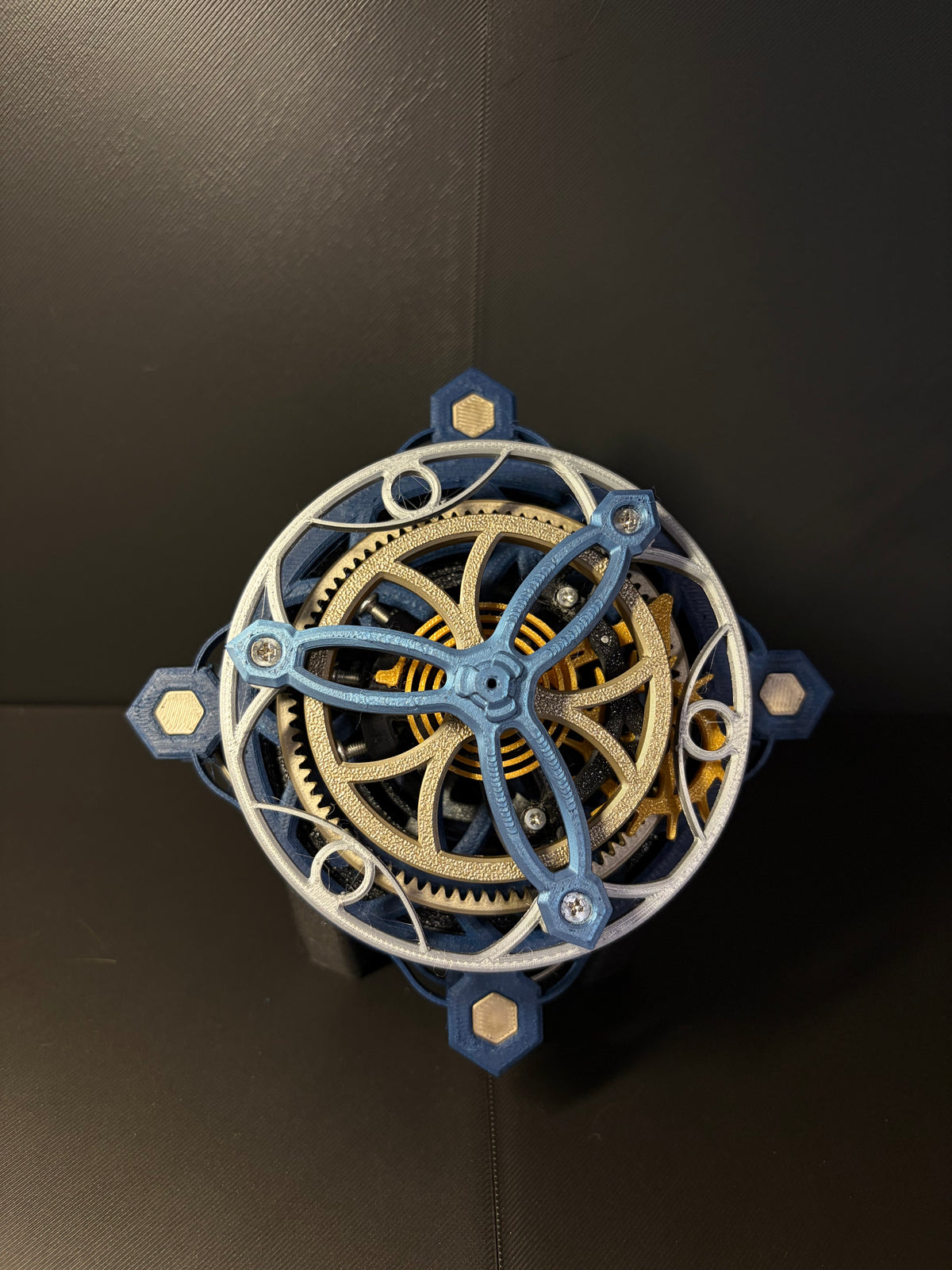
For a compact display, the Mechanica Tourbillon in the 75 mm Compact Edition offers the essential experience in a smaller footprint.
For a more substantial presence, the Tourbillon Desk 100 mm gives the rotating mechanism more room to command attention.
For collectors drawn to more complex movement, the Tourbillon Orbit adds a second axis of rotation. The entire outer housing turns, not only the inner cage. Its Reserve configuration runs for up to 15 minutes.
Each model includes a display stand and can be personalised with a name, initials, or short message of up to 20 characters.
Built to be watched
The finest mechanical watches reward close attention.
You notice the sweep of a seconds hand. The turning of a rotor. The changing tension of a power-reserve indicator. The small movement of a balance wheel beneath the crystal.
Mechanica extends that attention beyond the wrist.
It takes the hidden drama of a real mechanical movement and places it within reach. You can hold it. Wind it. Watch it. Hear it.
The scale is different. The purpose is different.
But the soul is familiar: stored energy, disciplined motion, and timeless engineering made visible.
Mechanica ships worldwide from Singapore and includes a 30-day warranty. Explore the collection or read the frequently asked questions before choosing the desk object that belongs in your space.